Malt
Malt
Malting is a process applied to cereal grains, in which the grains are made to germinate by soaking in water and are then quickly halted from germinating further by drying/heating with hot air. Thus, malting is a combination of two processes: the sprouting process and the kiln-drying process. These latter terms are often preferred when referring to the field of brewing for batches of beer or other beverages as they provide more specific information.
A maltings, sometimes called malthouse, or malting floor, is a building that houses the process of converting barley into malt, for use in the brewing or distilling process. This is done by kiln-drying the sprouted barley. This is usually done by spreading the sprouted barley on a perforated wooden floor. Smoke, coming from an oasting fireplace (via smoke channels) is then used to heat the wooden floor (and thus, the sprouted grain with it). The temperature thus employed is usually around 55° Celsius (131° Fahrenheit). A typical floor maltings is a long, single-story building with a floor that slopes slightly from one end of the building to the other. Floor maltings began to be phased out in the 1940s in favor of 'pneumatic plants'. Here large industrial fans are used to blow air through the germinating grain beds and to pass hot air through the malt being kilned. Like floor maltings these pneumatic plants are batch processes but of considerably greater size, typically 100 tonne batches compared with 20 tonne batches for a floor maltings.
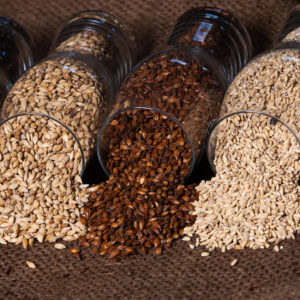
Malt is often divided into two categories by brewers: base malts and specialty malts. Base malts have enough diastatic power to convert their own starch and usually that of some amount of starch from unmalted grain, called adjuncts. Specialty malts have little diastatic power; they are used to provide flavor, color, or "body" (viscosity) to the finished beer. Caramel or crystal malts are specialty malts that have been subjected to heat treatment that converts their starches to sugars non-enzymatically. Within these categories are a variety of types distinguished largely by the kilning temperature (see mash ingredients). In addition, malts are distinguished by the two major species of barley used for malting, two-row and six-row.